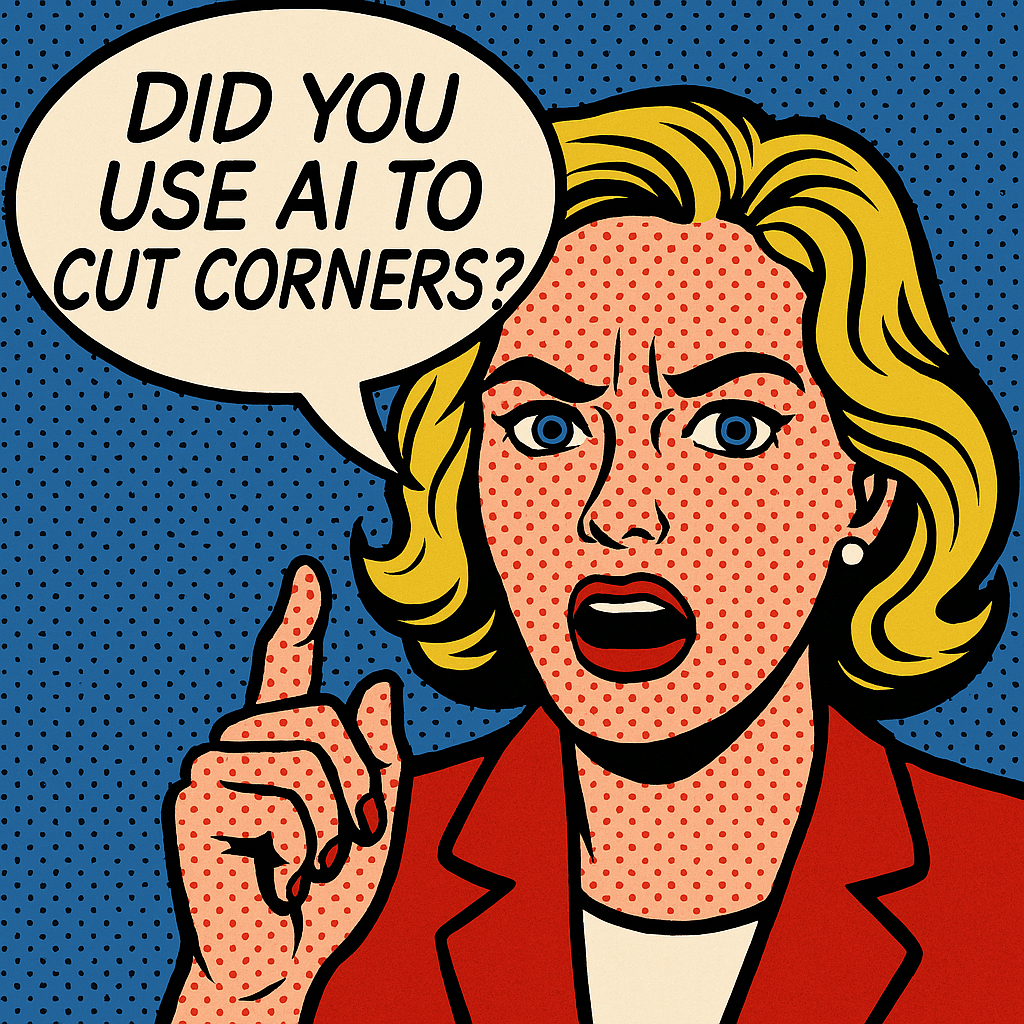
Many lawyers use AI responsibly to speed up research, organize documents, or draft early versions of routine filings. But there is a growing concern among clients that some attorneys are relying on AI as a shortcut and not as a tool while charging the same amount for legal fees. Clients are regularly noting a product that looks polished on the surface collapses under minimal scrutiny.
How Can I Tell The Difference?
The primary sign appears in the writing itself. AI‑generated text tends to have a certain smooth rhythm that feels “too even” or “robotic.” AI avoids complexity, rarely takes a firm position, and often politely repeats the same ideas over and over again using slightly different words. Other times, I read a document or brief in which the length of sentences never varies. Good writing in any context has texture, reflects judgment, and makes strategic choices. So when everything sounds generic, interchangeable, or oddly detached from the specific facts of a case I assume the document is either AI-generated or slapped together from prior documents without much thought.
Oh, there is also the use of contractions. Attorneys do not use them. Period. We also use citations consistently even when that consistent use is wrong. Variations in citation methodology are great clues. Similarly, overusage of cases from jurisdictions or trial courts without any precedential value make me curious.
How Can You Tell The Difference?
Attorneys who may have cut corners with AI will typically struggle to explain the reasoning behind the arguments in the document. They are like a child who is caught red-handed. Long pauses. Circling around searching for an answer. Paraphrasing the text rather explaining it. Lawyers who truly understand their own work can talk about it from multiple angles. They can explain why a case was cited, why a particular strategy was chosen, and how the argument fits into the broader litigation landscape. When the explanation feels thinner than the writing….
Clients may also notice inconsistencies between the polished document and the attorney’s earlier conversations Other times, clients may read a brief that frames the dispute in a way that does not match the facts you provided. AI models are trained to produce plausible legal language that do not appreciate the understand the nuances of your situation. If your attorney sends you a brief that feels disconnected from the story you’ve been telling for months, it may be because the draft was built from a template the attorney never fully reconciled with your actual facts. (I used AI to draft this sentence–notice the contraction.”)
These tips apply to the drafting of contracts, too–weirdly drafted contracts should concern you for the same reasons.
Billing records can offer additional insight. Unusually low time entries for tasks that normally require significant effort may indicate the attorney used AI to accelerate the work. But this is not outcome determinative. I would be more concerned if your attorney bills a large number of hours for work that appears generic, bland, and templated. But this is not an AI specific issue–clients have been served lukewarm soup for centuries through “cutting and pasting.” AI is just the newest way this happens.
Ultimately, the most reliable indicator is your own intuition. If something feels off—if the work seems too generic, too fast, too shallow, or too disconnected from your conversations—it is worth asking direct questions. A good attorney will welcome the opportunity to explain their process. A defensive or evasive response tells you everything you need to know. AI is not your enemy. Lazy lawyering is.
David Seidman is the principal and founder of Seidman Law Group, LLC. He serves as outside general counsel for companies, which requires him to consider a diverse range of corporate, dispute resolution and avoidance, contract drafting and negotiation, and other issues. In particular, he has a significant amount of experience in hospitality law by representing third party management companies, owners, and developers.
He can be reached at david@seidmanlawgroup.com or 312-399-7390.
This blog post is not legal advice. Please consult an experienced attorney to assist with your legal issues.
Photo credit: Image created using MS Copilot