If you use independent sales representatives, you have probably worried about some version of this: a rep lines up a job with your competitor while still carrying your line, and then asks you to cut a check for the commissions she booked on the way out the door.
Most business owners assume Illinois law simply requires you to pay. On October 19, 2026, the Illinois Appellate Court, Third District, held otherwise — on facts worth understanding before your next agreement goes out.
The case is Siwik v. Jasmine Enterprises Inc., 2026 IL App (3d) 250593.
What happened
Jasmine Enterprises sells bridal, bridesmaid, and mother-of-the-bride dresses. In 2019 it engaged Sylwia Siwik as a sales representative under a written agreement. Three provisions ended up mattering:
- Section 3.1 paid her a 7.5% commission on dresses ordered and shipped — and stated that commissions were not “earned or due and payable” until Jasmine actually shipped the order.
- Section 6.1 barred her, during the term of the agreement, from promoting, marketing, or selling competing dresses.
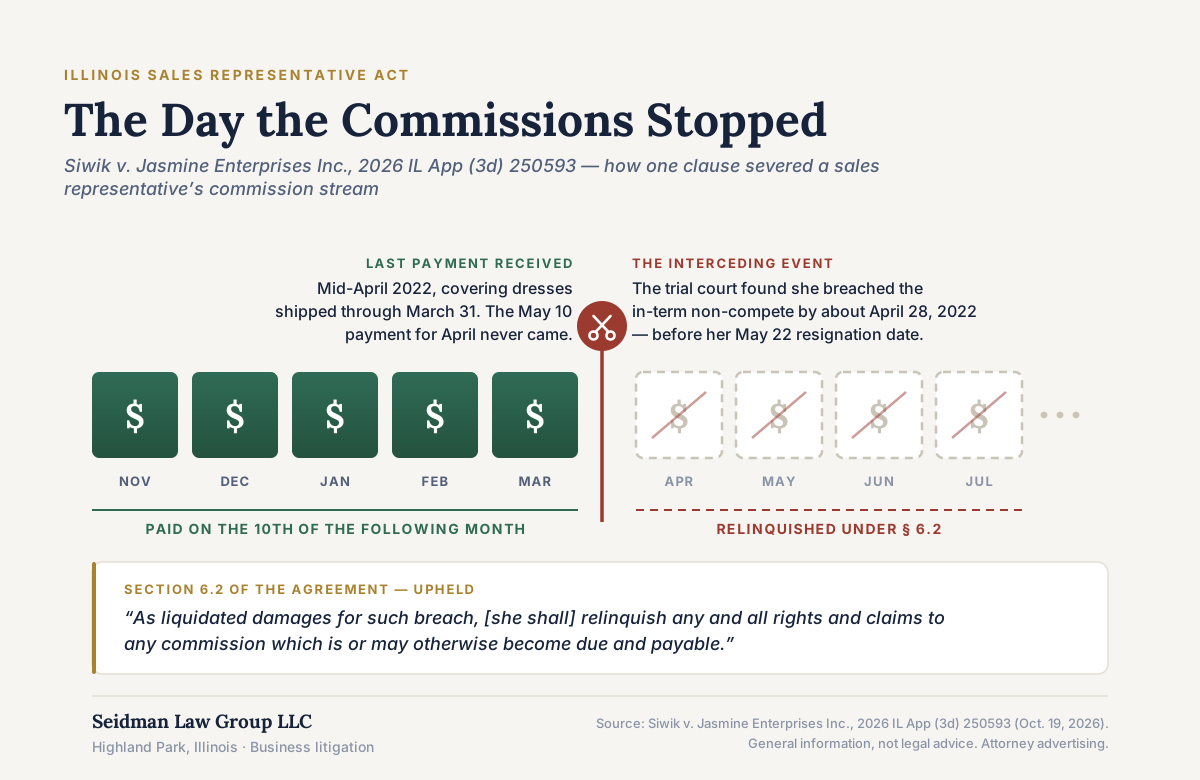
- Section 6.2 provided that if she violated Section 6.1, the agreement terminated automatically, and that “as liquidated damages for such breach,” she would “relinquish any and all rights and claims to any commission which is or may otherwise become due and payable.”
In April 2022, Siwik emailed a letter resigning effective May 22. Days later she signed on with Morilee, a competitor, and by the end of April a Morilee internal announcement was circulating that she was working for them. Jasmine terminated her on May 3 and refused to pay her April commissions.
She sued under the Illinois Sales Representative Act, 820 ILCS 120/0.01 et seq., seeking roughly $40,000. After a two-day bench trial, the DuPage County circuit court found she had breached Section 6.1 by about April 28 — well before her own May 22 resignation date — and entered judgment for Jasmine. The appellate court affirmed.
The part every business owner should read twice
The Sales Representative Act says two things that sound, at first, like they end the argument:
- All commissions due at the time of termination must be paid within 13 days; and
- Any provision purporting to waive the Act is void.
Siwik’s argument was straightforward: by letting Jasmine withhold commissions she had already earned, the court was allowing a private contract to override a statutory mandate.
The appellate court read the statute differently, and the distinction it drew is the whole case.
Section 1(2)(A) of the Act provides that when a commission becomes due is determined by the terms of the contract. So the 13-day payment clock is triggered only if, under the contract’s own terms, the representative is actually entitled to commissions at the moment of termination.
From there the court drew a line. Construing Section 2, it held (at ¶ 34) that an agreement would improperly waive the section’s provisions if it required the representative “to give up his or her rights or claims to commissions due at the time of the termination of the agreement” — but would not waive them if it provided “that commissions that were due prior to the termination of the contract would become no longer due at the time of termination, on account of an interceding event.”
Jasmine’s Section 6.2 fell on the lawful side of that line. Because Siwik had already breached Section 6.1, no commissions were due to her when the agreement terminated — so there was nothing for the 13-day rule to operate on.
The practical translation: a forfeiture provision tied to a triggering event that occurs before termination can survive the Act. A provision that simply strips a rep of commissions already due at termination will not.
The second holding: why the forfeiture clause wasn’t an illegal penalty
Siwik also argued that Section 6.2 was an unenforceable penalty rather than a valid liquidated damages clause. The court rejected that too — and the reasoning is a practical lesson in how these clauses get tested.
Illinois applies a three-part test. A liquidated damages clause is generally valid where:
- the parties intended to agree in advance to the settlement of damages that might arise from the breach;
- the amount was reasonable at the time of contracting, bearing some relation to the damages which might be sustained; and
- actual damages would be uncertain in amount and difficult to prove.
(Med+Plus Neck & Back Pain Center, S.C. v. Noffsinger, 311 Ill. App. 3d 853, 860 (2000).)
Jasmine’s president and vice-president, Kyle and Cynthia Yin, met that test at trial with testimony, not argument. What the record contained:
- The agreement had been negotiated. Siwik and Cynthia each testified that Siwik negotiated terms before signing; Kyle testified he and Siwik discussed the agreement before execution (¶ 37). (On cross, Siwik testified she had asked for revisions to portions of the agreement other than sections 6.1 and 6.2.)
- The company could explain the harm. Early departure plus competitive activity meant lost revenue; in a small industry where Jasmine and Morilee sold identical products, a rep carrying both lines would also create customer confusion (¶ 38).
- The company could explain why damages were unquantifiable. The amount would vary with the timing of the breach within a six-month selling season, the circumstances surrounding it, the exact nature of the conduct, and the competition at hand (¶ 39).
- The clause had been revised downward. The original template carried a flat $50,000 liquidated damages figure. Kyle and Cynthia testified that it was replaced with the commission-relinquishment measure after earlier reps said $50,000 was too large compared to what they actually earned (¶¶ 13, 18, 39).
Now, the court’s own stated basis was narrower than any of that. At ¶ 40 it held that although Siwik “broadly assert[ed]” the clause was not a reasonable forecast of actual damages, “none of the specific facts that Kyle and Cynthia testified to regarding their measure of liquidated damages were meaningfully contested at trial.” That — the absence of contrary evidence — is what the holding rests on.
Which is itself the lesson. Jasmine won this point because it had witnesses who could speak to each element and an opponent who did not engage with the specifics.
Four takeaways if you use sales representatives
1. Where the forfeiture trigger sits in time is not a drafting detail — it is the case. Under Siwik, a clause keyed to conduct occurring during the term stands on very different footing than one that simply withholds commissions at termination.
2. Define when commissions are earned, and do it precisely. Jasmine’s agreement stated commissions were not earned or due until the order actually shipped. Because the Act defers to the contract on when a commission becomes due, that single sentence set the terms of the entire dispute.
3. Be able to explain your liquidated damages number — out loud, under oath. Two witnesses testified to why that measure was chosen and why actual damages would be hard to prove, and none of those specifics was contested. If nobody at your company can answer “why this number?”, you have a clause that reads well and tries badly.
4. Consider a measure that scales. We should be careful here: the court never evaluated the discarded $50,000 flat figure, and the reason Jasmine dropped it was commercial, not judicial — reps said it was too big relative to their earnings. But the second element of the Illinois test asks whether the amount bore some relation to the damages that might be sustained. A measure tied to an individual rep’s own commissions speaks to that question in a way a round, uniform number does not.
Important limits on this decision
- Siwik was decided on the specific language of this agreement. A differently worded forfeiture clause can easily come out the other way — and the court was explicit that a clause stripping commissions due at termination would violate the Act.
- The outcome rested heavily on a factual finding at trial that Siwik had breached the non-compete provision before her resignation took effect. Change that finding and the analysis changes with it.
- The opinion was filed October 19, 2026 and remains subject to further review. Slip opinions can be modified or withdrawn, and the Illinois Supreme Court has not spoken on this question.
- The Sales Representative Act exists specifically to protect representatives’ bargaining power, and Illinois courts treat it as a statement of fundamental public policy (¶ 30). Aggressive forfeiture drafting invites a fight.
David Seidman is the principal and founder of Seidman Law Group, LLC. He serves as outside general counsel for companies, which requires him to consider a diverse range of corporate, dispute resolution and avoidance, contract drafting and negotiation, real estate, and other issues. He can be reached at david@seidmanlawgroup.com or 312-399-7390.
This blog post is not legal advice. Please consult an experienced attorney to assist with your legal issues.