A “Closing” is often treated as the finish line. But sometimes the Closing is merely the beginning of a complex period of operational co-dependence. When a buyer acquires a business unit that was previously integrated into a larger parent company, that unit rarely arrives as a standalone entity. It often lacks its own HR systems, IT infrastructure, payroll processing, or even a dedicated tax department.
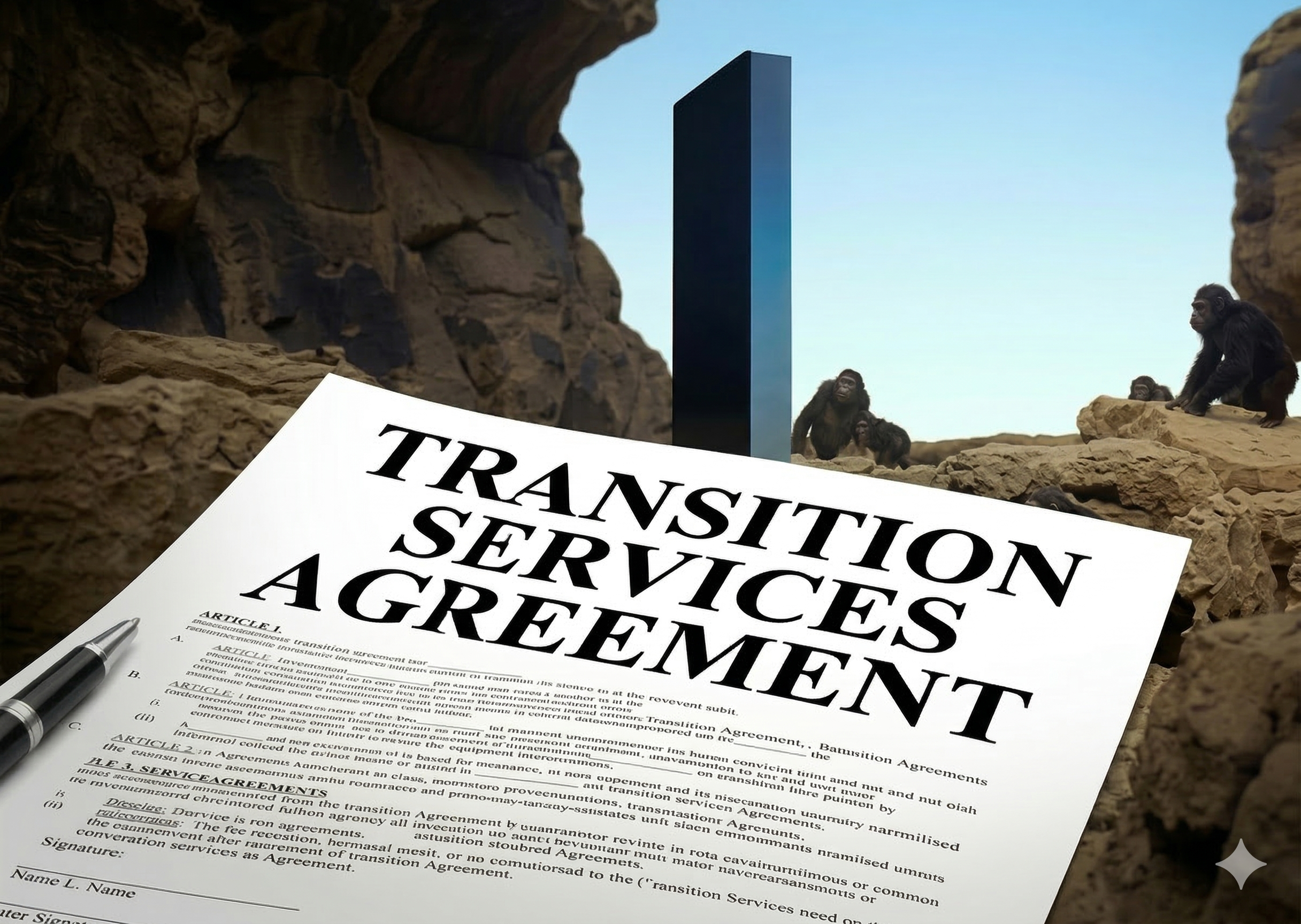
The Transition Services Agreement (TSA) serves as the contractual bridge that allows the seller to provide back-office and operational services to the buyer for a limited period after the deal closes. While often treated as a secondary document during negotiations, a poorly drafted TSA can lead to post-closing disputes, operational paralysis, and significant value erosion.
Why the TSA is Necessary: The Reality From The Outset
When a parent company sells a subsidiary or a division to a buyer, the target usually suffers from intense operational interdependency. The target’s employees might be on the seller’s health insurance plan, their data might live on the seller’s servers, and their invoices might be processed by the seller’s accounts payable team. The TSA ensures Day One readiness by allowing the buyer to operate the business from the moment the keys are handed over while simultaneously building out its own independent infrastructure.
Key Legal Components of a TSA
A robust TSA must balance the seller’s desire to exit the relationship with the buyer’s need for business continuity. The most frequent source of litigation is ambiguity regarding the scope of services. Buyers should insist that services be provided at the same level, quality, and priority as they were provided prior to the sale. Conversely, sellers will try to limit their obligation to reasonable efforts. To account for human error during the drafting phase, a catch-all or omitted services clause is vital to require the seller to provide any services historically provided to the target even if they were not explicitly listed in the schedules.
Pricing and pass-through costs also require careful calibration. In most M&A deals, the seller is not a service provider by trade, and therefore TSAs are often priced at cost. However, sellers may push for a small administrative markup to cover the internal headache of managing the transition. If the seller has to pay a third-party vendor for additional licenses, those costs are typically passed directly to the buyer.
The standard of liability and indemnification is often the most heavily negotiated legal section. Sellers generally argue that because they are providing services at cost, they should only be liable in cases of gross negligence or willful misconduct. Buyers argue that any mistake in payroll or data handling results in direct financial loss and should be held to a standard of ordinary negligence. The common compromise involves a liability cap—often tied to the total fees paid under the TSA—with exceptions for data breaches or gross negligence.
Business Strategy: Managing the Transition
A TSA is as much a project management challenge as it is a legal one. For the seller, providing these services keeps stranded costs on the books because they must retain staff who are servicing a business they no longer own. The seller’s primary goal is to terminate the TSA as quickly as possible to downsize their own overhead.
To ensure the buyer does not treat the seller as a permanent back-office, many TSAs use escalating pricing models. For instance, services might be provided at cost for the first six months, then increase by twenty-five percent for the next three months, and eventually reach fifty percent above cost by the end of the year. This financial pressure incentivizes the buyer to complete their IT migration and hire their own staff on a strict timeline.
Critical Categories of Service
While every deal is different, most TSAs focus on four primary areas. Information Technology is the most complex, involving data migration, software licensing, and cybersecurity. The TSA must address who owns the data and how it will be scrubbed from the seller’s systems at the end of the term. Human Resources and Benefits involve payroll, retirement fund administration, and health insurance, which require significant lead time for compliance. Accounting and Finance services cover tax reporting and treasury functions, while Supply Chain and Logistics ensure continued access to shared warehouses and procurement contracts.
Potential Pitfalls: The “Shadow” Risks
The issue of third-party consents is where many TSAs fail. A seller might agree to provide the buyer with access to an enterprise software system, but the seller’s license with the software vendor might prohibit use by third parties. During due diligence, the legal team must review all underlying vendor contracts to see if a change of control or third-party access fee is required.
Furthermore, the TSA should not just cover the execution of work but also the transfer of knowledge. The buyer needs to ensure that by the end of the transition period, their new employees understand the specific workflows the seller was previously handling. Additionally, in the era of strict data privacy laws like GDPR, a TSA is a data-sharing minefield. The agreement must include a detailed data processing addendum that outlines how personally identifiable information will be protected while it sits on the seller’s servers.
Termination and “The Handshake”
The TSA usually terminates on a service-by-service basis, allowing the buyer to notice out of specific functions as they stand up their own internal departments. Even after the final service is terminated, certain obligations should survive. These include confidentiality regarding the data exchanged, the right to audit the seller’s invoices for accuracy, and indemnification for third-party claims arising from the service period.
In summary, the seller aims to minimize distraction and cost through hard-stop dates and limited liability. The buyer focuses on maintaining business continuity through catch-all clauses and rights to extend the term if migration is delayed. Legal counsel plays the role of risk mitigator by prioritizing third-party consents and cybersecurity protocols. By treating the TSA as a strategic tool rather than a boilerplate afterthought, both parties can ensure a successful transition and a clean break.
David Seidman is the principal and founder of Seidman Law Group, LLC. He serves as outside general counsel for companies, which requires him to consider a diverse range of corporate, dispute resolution and avoidance, contract drafting and negotiation, and other issues. In particular, he has a significant amount of experience in hospitality law by representing third party management companies, owners, and developers.
He can be reached at david@seidmanlawgroup.com or 312-399-7390.
This blog post is not legal advice. Please consult an experienced attorney to assist with your legal issues.
Photo credit: Created with Gemini