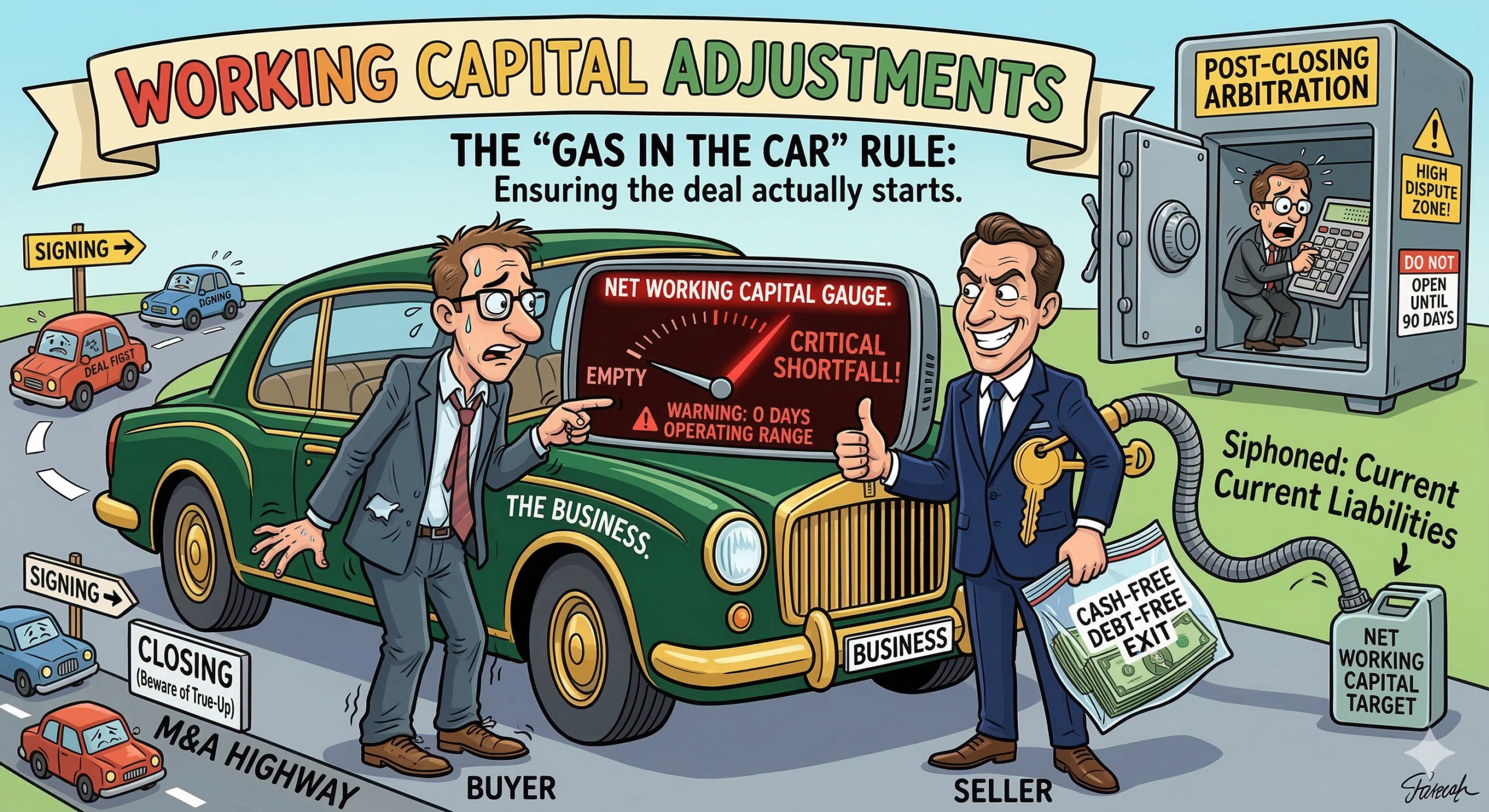
The purchase price is often adjusted post-closing in M&A deals because the working capital delivered at closing is often not adequate when compared to the negotiated target. This makes intuitive sense. The buyer expects the business to be delivered with a “normal” level of current assets to operate the business in the ordinary course. On the other hand, the Seller wants to make sure he is not ultimately losing money by handing over an amount that is more than necessary to run the business.
This “working capital adjustment” is supposed to a mechanical calculation of a formula agreed upon by the parties. Yet working capital adjustments remain the most common source of post-closing disputes. Imprecise contract language, ambiguous accounting references, and misaligned expectations or disparate accounting practices between buyer and seller can turn a routine adjustment into an expensive post-closing fight. Understanding where these disputes arise and how to best to mitigate the risk of them prior to signing will materially reduce post-close friction.
“Consistent With Past Practice”? Did We Even Have Practices? Did We Always Use Them?
Many purchase agreements require working capital components to be calculated in accordance with GAAP (subject to agreed exceptions), “consistently applied,” or “consistent with past practice.” Problems arise when a target company’s past practices were informal or undocumented, inconsistent over time, or changed as the company matured, in each case even while GAAP-compliant.
Then there is the most obvious issue: the buyer and seller may simply interpret “consistency” or apply GAAP differently…. particularly when the preferred standard favors that party’s position.
Ambiguous accounting standards invite disputes. An important note on this point: rather than have your attorneys run to court or an arbitrator, businesspeople may want to consider using language that requires these issues be resolved by the parties through mediation before third party attorneys and accountants start churning those fees.
The Working Capital Peg May No Longer Work
This scenario is easy to imagine in 2026. What if the cost of oil is 50% higher two days after the deal is executed?
A working capital peg is meant to reflect a “normalized” level of working capital based on trending historical averages. Trailing twelve month working capital balances are often used as a starting data point but the ultimate number is derived from a variety of incomplete or old data. Likewise, seasonal fluctuations that are not fully accounted for, one-time items that are embedded in the baseline, growth or contraction trends that are ignored and pre-closing operational changes are overlooked on a regular basis. There is no excuse for this to happen.
When the working capital peg does not reflect the business reality, the value of the transaction to the parties is materially affected. The working capital peg will not be the fair number envisioned by the parties.
When this happens, the post-closing true-up becomes a renegotiation of the purchase price.
How Exactly Are We Resolving This?
To repeat: the best agreements have the parties themselves trying to resolve the dispute without attorneys or accountants involved. Let the businesspeople try to cut a deal before the service provider fees become astronomical.
Unfortunately, most purchase agreements require the parties mediate, arbitrate, or litigate without taking time for a pause. When accountants are engaged to resolve disputes, issues are raised concerning the scope of the accountant’s authority, the standards of review, the ability to consider extrinsic evidence and timelines and cost allocation. A great way for a party to make the dispute drag on forever to that party’s benefit even if there is an attorney’s fee clause provision.
Do Not Fumble Near The Goal Line
The methodology for working capital adjustments and determination of the peg are usually finalized late in the drafting process. The parties are ready to move forward. They do not want to fight over what they deem picayune legal issues. And everyone has read the same draft over and over and over.
This is when the parties agree to punt issues to a later date (to keep the football references going). In so doing, they are assuming they will work out a reasonable resolution even though they just failed to reach an agreement.
And this is why both corporate attorneys and litigators have jobs.
David Seidman is the principal and founder of Seidman Law Group, LLC. He serves as outside general counsel for companies, which requires him to consider a diverse range of corporate, dispute resolution and avoidance, contract drafting and negotiation, and other issues. In particular, he has a significant amount of experience in hospitality law by representing third party management companies, owners, and developers.
He can be reached at david@seidmanlawgroup.com or 312-399-7390.
This blog post is not legal advice. Please consult an experienced attorney to assist with your legal issues.
Photo credit: Image created using Gemini