Every few months, generative AI forces a court to reinvent copyright law from first principles. This week, the Third Circuit looked at that invitation and said, politely, “not today, but thanks for asking.”
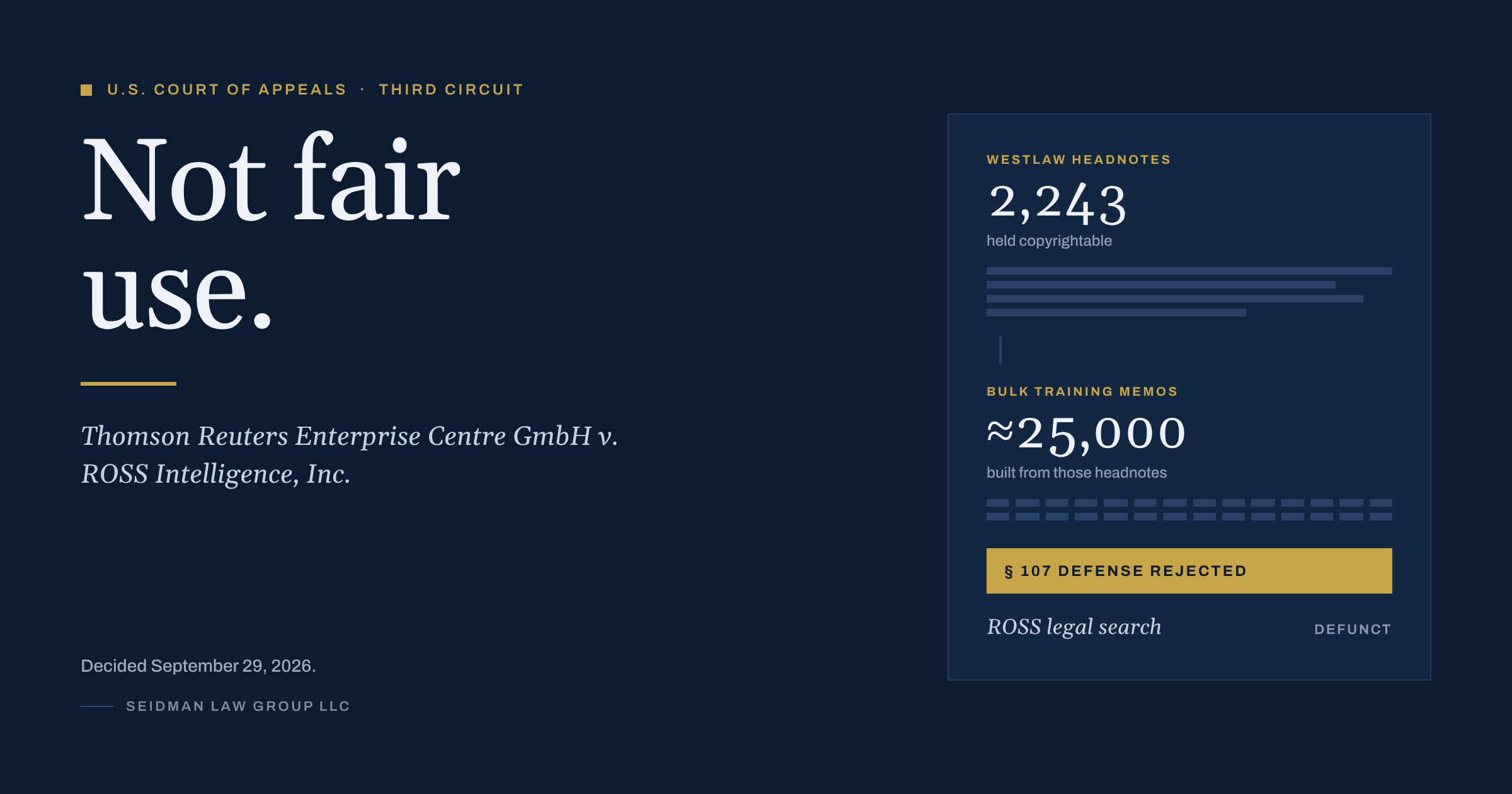
In Thomson Reuters Enterprise Centre GmbH v. ROSS Intelligence Inc., decided September 29, 2026, the Third Circuit affirmed that ROSS Intelligence’s use of roughly 25,000 Westlaw-derived training memos — built from Thomson Reuters’ copyrighted headnotes — did not qualify as fair use. ROSS, a now-defunct legal research startup, had paired Westlaw’s editorial summaries with the underlying judicial opinion passages to teach its own AI search tool which text answered which legal question. Thomson Reuters sued. ROSS lost at the district court. ROSS lost again on appeal.
The court’s reasoning leaned on two of the four fair-use factors doing the heavy lifting, as they usually do. On purpose and character, the panel found ROSS’s use “highly commercial and only minimally transformative” — both companies were using the headnotes for the exact same purpose: helping lawyers find relevant case law faster. Transformation requires transformation, not just a different corporate logo on the output. On market harm, Thomson Reuters showed injury in two markets at once: the direct legal-research market where ROSS was built to compete with Westlaw, and the newer, still-forming market for licensing editorial content specifically as AI training data. Courts have increasingly treated that second market — the licensing market a defendant’s conduct would otherwise cannibalize — as its own independent harm, and this opinion is another brick in that wall.
Here’s the part that should keep every AI general counsel’s coffee a little cold, though: the Third Circuit went out of its way to say this was not a generative AI case. ROSS’s tool retrieved and ranked existing passages; it didn’t generate new expression the way a large language model does. The court explicitly declined to resolve whether training a generative model on copyrighted text to produce new output is fair use — which means the actually hard question, the one every AI company and every publisher is suing each other over right now, is still sitting there, un-decided, waiting for the next appeal.
Why SLG clients should care: If you’re a client building, buying, licensing, or investing in anything with “AI” in the pitch deck, the message from the Third Circuit is that courts will look past the technology and ask the same two questions they’ve always asked: did you transform the work, and did you hurt the market for it? That analysis belongs in diligence memos and representations-and-warranties language before the investment closes, not after opposing counsel finds it in discovery. We are already asking this question in deal review.
David Seidman is the principal and founder of Seidman Law Group, LLC. He serves as outside general counsel for companies, which requires him to consider a diverse range of corporate, dispute resolution and avoidance, contract drafting and negotiation, real estate, and other issues. He can be reached at david@seidmanlawgroup.com or 312-399-7390.
This blog post is not legal advice. Please consult an experienced attorney to assist with your legal issues.